

Other activities
Other projects supported by the application of the Discrete Choice Experiment
Calibra has intensified its activities in the use of advanced statistical methodologies, with a focus on digital solutions and technologies based on Artificial Intelligence, to ensure high added value and concrete results for customers in the pharmaceutical sector.
Patient Reported Outcomes Measures (PROMs)
PROMs are increasingly used to capture the impact of therapies on patients’ lives. They are assessment tools that collect information directly from patients about their health, quality of life, and the impact of a disease or treatment.
Unlike traditional clinical measures, which are based on the physician's observations, PROMs give patients a voice, allowing them to express their experience subjectively.
Patient-reported outcomes are important because they provide the patient's perspective on a disease or treatment that cannot be detected by clinical measurement but may be as important to patients themselves and their adherence to treatment as clinical measurement.
PROMs can be developed in specific areas with the direct input of clinicians and patients using the Discrete Choice Experiment.
Quality of Life Indices
The DCE can be used to develop more appropriate Quality of Life Indices that are increasingly valued by regulatory authorities and pharmaceutical companies themselves, which use them to express the effectiveness of their drugs in a different way, through the voice of the patient.
Psychometric Scales and Composite Indices
The DCE can be used to develop psychometric scales and composite/predictive indices to objectively and comparably assess/measure certain clinical, instrumental, and biochemical parameters. These parameters can be combined into a single Composite Index that allows for better assessment of the effectiveness of a treatment and the impact of the disease on the patient.
Development of Decision Aid Tools combining DCE and Artificial Intelligence
Development and application of the DCE statistical methodology in digital devices that can also be powered by Artificial Intelligence, in order to develop tools capable of monitoring the preferences and choice algorithms of clinicians and patients over time, based on the severity of the disease, new therapeutic solutions available, or other aspects of interest to the scientific community and institutions. Decision Aid Tools (e.g., apps) can be developed which, with the contribution of Artificial Intelligence, are capable of promoting increasingly personalized medicine.
Decision Aid Tools are digital devices that combine Discrete Choice Experimentation with Artificial Intelligence, providing tools capable of assessing the preferences of a specific patient in real time and thus supporting the selection of a personalized therapy that promotes greater patient adherence.
Customized DCE
Customized DCEs can be developed to allow physicians to learn about the preferences of the patient they are seeing in real time. This would enable physicians to avoid making theoretical choices and instead base their decisions on specific, personalized information provided by the patient they are seeing.
Clinical Trials and Real World Studies
In clinical research, preference analysis can also guide decisions about the relevance to patients (what is a "significant" effect for patients?) of endpoints in clinical trials, real-world evaluation studies, and post-marketing activities.
Value of the projects
Discrete Choice Experiment projects and Consensus projects are recognized as valuable by various stakeholders in the healthcare sector:
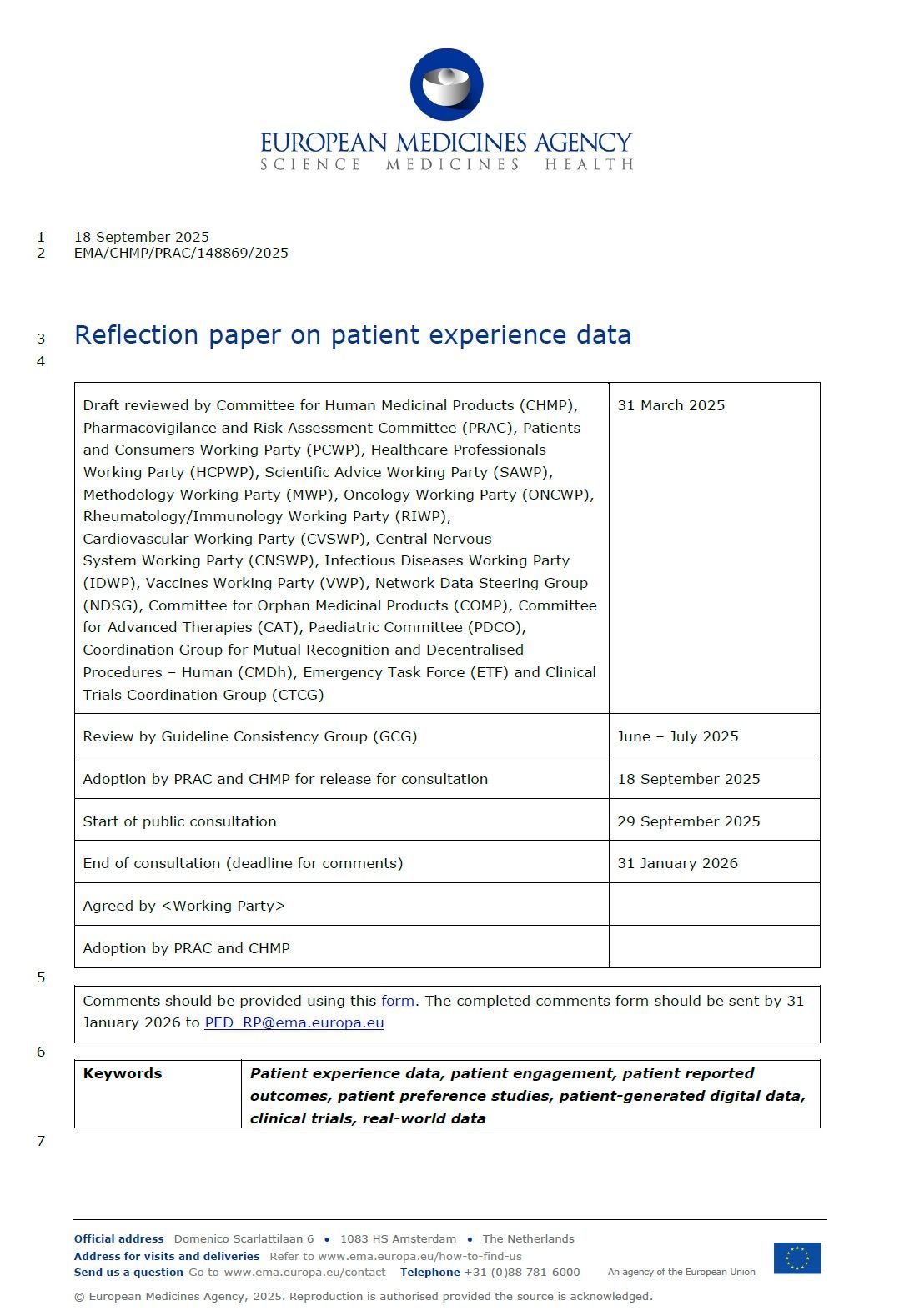
- Health authorities (AIFA, EMA, FDA), which are increasingly taking patients' opinions and preferences into account. The EMA recently published (September 2025) a Reflection Paper on the importance of data that collects and expresses patients' experiences.
- The scientific community, which can expand its knowledge by publishing results in internationally indexed journals
- The company, which can quickly gain insight into the intentions of patients, clinicians, and payors using a validated online platform capable of reaching stakeholders throughout the country and abroad without logistical costs